

Why Google is deleting reviews at record levels

In 2025, Google is removing reviews at unprecedented rates – and it is not accidental.
Our industry analysis of 60,000 Google Business Profiles shows that deletions are being driven by a mix of:
- Automated moderation.
- Industry-wide risk factors.
- Increased enforcement against incentivized reviews.
- Local regulatory pressure.
Together, these forces have significant implications for businesses and local search visibility.
Review deletions are on the up globally

Data collected from tens of thousands of Google Business Profile listings across multiple countries by GMBapi.com show a sharp increase in deleted reviews between January and July 2025.
The surge began accelerating toward the end of Q1 and gained momentum mid-year, with a growing share of monitored locations experiencing at least one review removal in a given week.
This is not limited to negative feedback.
While one-star reviews continue to be taken down, five-star reviews now account for a sizable share of deletions.
That pattern suggests Google is applying stricter enforcement, including on positive reviews, as it works to maintain authenticity and trust.
More recently, Google has begun asking members of its Local Guide community whether businesses are incentivizing reviews, likely in response to AI-driven flags for suspicious activity.
Dig deeper: Google’s review deletions: Why 5-star reviews are disappearing
Not all industries are treated the same
Review deletion patterns vary significantly by business category.
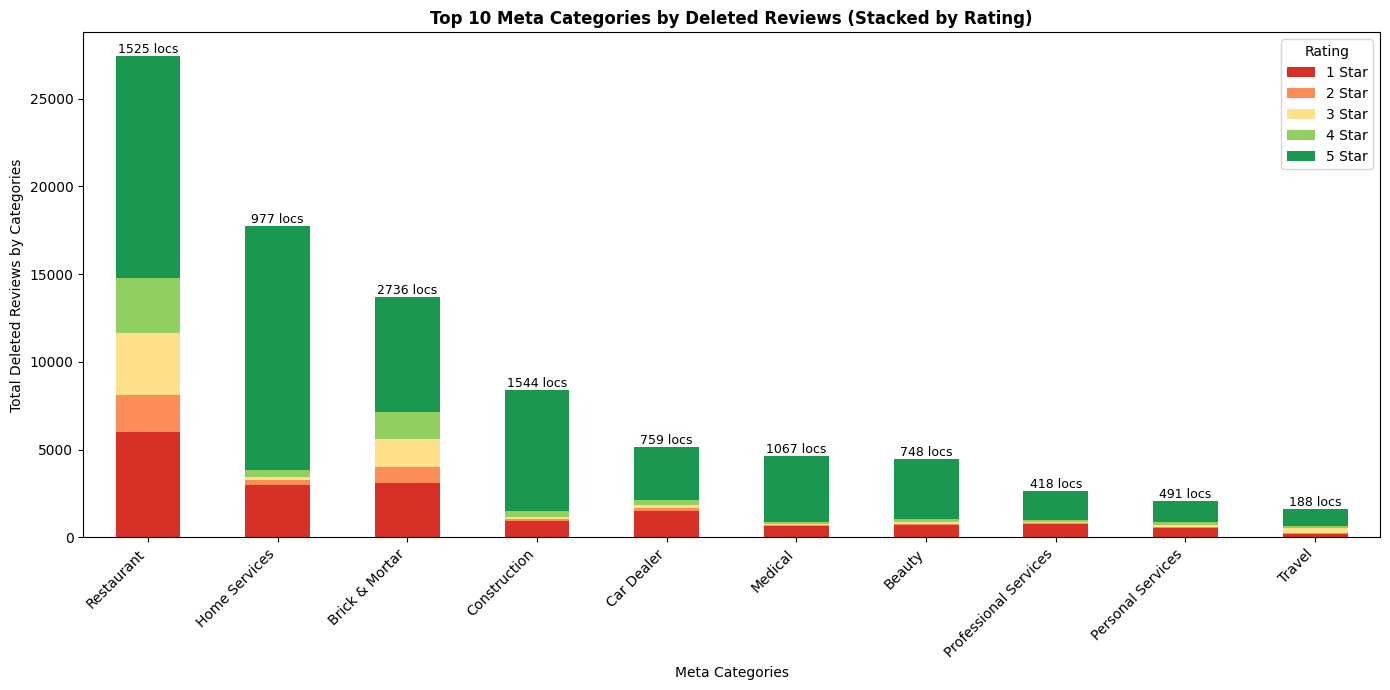
Restaurants account for the highest volume of deleted reviews, followed by home services, brick-and-mortar retail, and construction.
These categories generate large volumes of reviews, and removals occur across both recent and older submissions.
That distribution points to ongoing enforcement, not isolated cleanup efforts.
By contrast, medical services, beauty, and professional services see fewer deletions overall.
However, closer analysis reveals distinct and consistent patterns within those categories.
What review ratings reveal about industry bias

Looking at deleted reviews as a share of total removals within each category reveals distinct moderation patterns.
In restaurants and general retail, deleted reviews are relatively evenly distributed across one- to five-star ratings.
By contrast, medical services and home services show a strong skew toward five-star review deletions, with far fewer removals in the middle of the rating spectrum.
That imbalance suggests positive reviews in higher-risk or regulated categories face closer scrutiny, likely tied to concerns around trust, safety, and compliance.
These differences do not appear to stem from manual, category-specific policy decisions.
Instead, they reflect how Google’s automated systems adjust enforcement based on perceived industry risk.
Dig deeper: 7 local SEO wins you get from keyword-rich Google reviews
Get the newsletter search marketers rely on.
See terms.
Timing matters: Early vs. retroactive deletions
The age of a review plays a significant role in when it is removed.
In medical and home services, a large share of deleted reviews disappear within the first six months after posting.
That timing points to early intervention by automated systems evaluating language, reviewer behavior, and other risk signals.
Restaurants and brick-and-mortar retail show a different pattern.
Many deleted reviews in these categories are more than two years old, suggesting retroactive enforcement as detection systems improve or new suspicious patterns emerge.
It may also reflect efforts to refresh older review profiles.
For businesses, this means reviews can disappear long after they are posted, often without warning.
Geography adds further complexity
Industry alone does not tell the full story. Location matters.
In English-speaking markets such as the U.S., UK, Canada, and Australia, deleted reviews skew heavily toward five-star ratings.
That trend aligns with increased AI-driven moderation aimed at reducing review spam and incentivized positive feedback.
Germany stands apart.
Analysis of thousands of German business listings shows a higher share of deleted reviews are low-rated, and most are removed within weeks of posting.
This pattern aligns with Germany’s strict defamation laws, which permit businesses to legally challenge negative reviews and require platforms to take prompt action upon notification.
In short:
- AI-driven enforcement dominates in many English-speaking markets.
- Legal takedowns play a much larger role in Germany.
What this means for local SEO and small business owners
The rise in review deletions creates two primary challenges.
- Trust erosion: When legitimate reviews, whether positive or negative, disappear without explanation, confidence in review platforms begins to weaken.
- Data distortion: Deleted reviews affect star ratings, performance benchmarks, and conversion signals that businesses rely on for local SEO and reputation management.
For SEO practitioners, small businesses, and multi-location brands, review monitoring is no longer optional.
Understanding when, where, and which reviews are removed is now as important as generating them.
Dig deeper: Why Google reviews will power up your local SEO
The forces reshaping review visibility
Three developments are shaping review visibility:
- More automated moderation, with AI evaluating reviews in real time and retroactively.
- Greater legal influence in regions with strict defamation laws.
- Increased reliance on third-party monitoring tools as businesses seek independent records of review deletion activity.
As moderation becomes more automated and more influenced by local law, sentiment alone will not guarantee review visibility.
In local SEO, reviews – especially recent ones with detailed context – remain a critical authority signal for both users and search engines.
Staying ahead now means not only collecting new reviews, but also closely tracking and understanding removals.
Reputation management increasingly requires attention on both fronts.






Recent Comments