


What 75 SEO thought leaders reveal about volatility in the GEO debate [Research]
![What 75 AI SEO influencers reveal about the GEO debate on LinkedIn [Research]](https://seoauthority.com.au/wp-content/uploads/2026/01/What-75-AI-SEO-influencers-reveal-about-the-GEO-debate-on-LinkedIn-Research.png)
The SEO versus GEO debate has dominated industry discourse over the past year.
New acronyms appear weekly, sentiment swings quickly, and even trusted voices often contradict positions they held just months earlier.
That volatility isn’t happening at the edges of the industry.
It’s coming from a small group of highly visible SEO influencers whose framing of AI-era search shifts in response to news cycles, platform announcements, and branding pressure.
To understand how widespread – and how unstable – this discourse has become, we analyzed how 75 leading SEO influencers discuss AI-driven search on LinkedIn.
The goal wasn’t to decide which acronym would win. It was to measure consistency, sentiment, and volatility in how influential practitioners describe the same underlying shift in discovery.
Working with Search Engine Land’s Danny Goodwin, we examined all 2025 LinkedIn posts from these influencers that referenced AI-related SEO terms, including GEO, AIO, AISEO, AEO, LLMO, SXO, and ASO.
Using VADER sentiment analysis, we scored each post on a -1 to +1 scale and measured volatility as the standard deviation of sentiment over time.
All data was anonymized to preserve relational patterns without exposing individuals.
‘SEO’ is still the most commonly used LinkedIn headline – even as AI terms dominate posts
In 2025, industry leaders were passionate about debating AI-era search terms in their LinkedIn posts, but they weren’t comfortable rebranding their personal LinkedIn “headlines” (highlighted below) using the same terminology.

According to our data scrape, 43% of SEO thought leaders include “SEO” in their LinkedIn headline, compared to 21% who reference “AI” and just 3% who reference “GEO.”
Mind the gap. We’re not doing a large-scale rebranding from SEO to GEO because AI brand visibility is still largely reliant on the most effective SEO strategies we’ve all deployed for the past decade:
Well-structured, persona- and buyer-journey-led content hubs
Brands need to invest in on-site content hubs that answer real FAQs and conversational queries rooted in buyer intent.
Your content depth across the full journey – awareness (e.g., education around solutions to pain points), consideration (e.g., proof in testimonials and case studies), and decision stage (e.g., comparison charts) – creates compounding value for users and stronger entity signals for AI search and algorithms alike.
Off-site authority signals that establish your brand as a trusted entity
Publish original research, expert commentary, and definitive explainers that earn mentions from authoritative, widely cited sources, including:
- Mainstream news outlets.
- Niche-relevant publishers.
- Leading podcasters.
- Engaged Reddit communities.
These signals expand your digital footprint, strengthen entity recognition, and reinforce brand trust.
Use audience intelligence tools like SparkToro to identify the platforms, communities, and topics your digital PR strategy should prioritize.

Dig deeper: The origins of SEO and what they mean for GEO and AIO
Three new AI search terms lead the pack, and optimism is higher than you’d expect
While industry leaders aren’t scrambling to update their LinkedIn headlines (quite yet), their LinkedIn posts reveal which three terms are starting to gain traction:
- 63% of industry leaders reference AIO (AI optimization), with 77% of their posts having a positive sentiment.
- 59% reference GEO (generative engine optimization), 82% positive.
Our data visualization below compares both adoption frequency (how many leaders reference each term in their LinkedIn posts) and sentiment (how positively those terms are framed in each post).
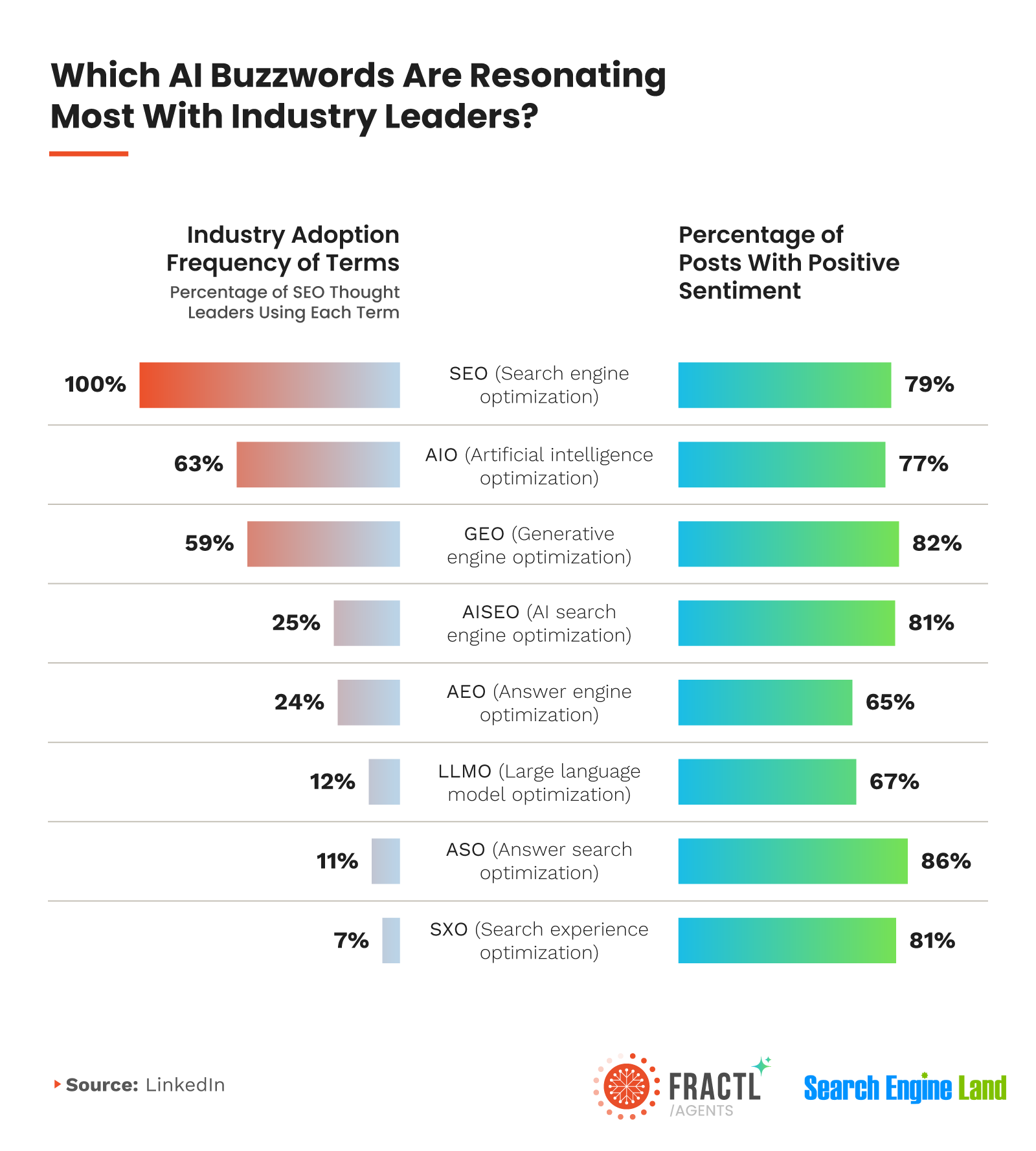
Over 70% of posts using AI-related search terms carry a positive tone.
That matters, because sentiment is often a leading indicator of adoption.
When optimism collapses, usage follows. That’s not what we’re seeing here.
When we step outside of our industry influence analysis into the broader SEO community debate, we see that AEO, LLMO, and AIO resonate more with general audiences, but GEO stands out for its consistency – 82% positive among SEO thought leaders and nearly identical sentiment across the broader LinkedIn population.
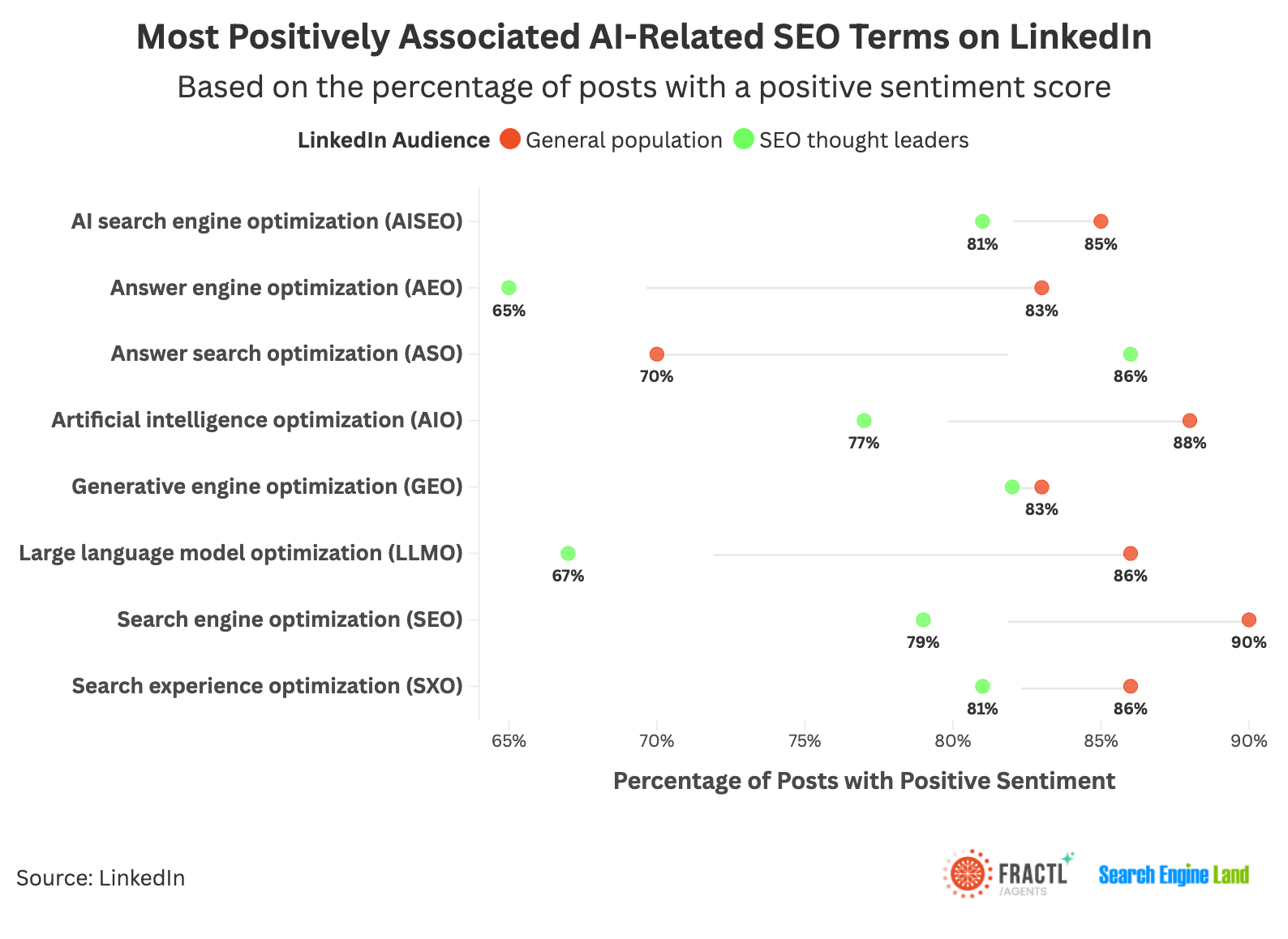
SEO remains the industry’s foundation, but a year of discourse makes one thing clear: this isn’t fragmentation – it’s an emerging platform in its naming and strategy-formation phase.
The real negotiation isn’t about acronyms. It’s about how we describe brand visibility when answers are synthesized, not ranked.
The takeaway?
Don’t over-optimize your digital marketing engine around any single term, strategy, or platform.
Build timely, value-driven content for your audience, then repurpose it across the channels where they already engage.
That’s how brands survive platform churn, especially in a digital ecosystem littered with once-hyped platforms like Vine, Google+, and Clubhouse.
Dig deeper: What is AI, actually, and how is it affecting SEO?
Nomenclature volatility is the discourse signal hiding in plain sight
The most eye-opening stat from our research is that fewer than one-third of thought leaders have maintained consistent usage of AI-related SEO terminology and sentiment over the past year.
Drilling into the data, we found:
- 35% of thought leaders show positive sentiment toward AI-related search terms, but lack consistency.
- Only just over one-third land in the quadrant that’s both positive and stable.
- Visibility and volatility often move together. Trust and consistency do, too – but in the opposite direction.
The issue isn’t whether leaders are right or wrong.
It’s how often their framing shifts in response to news cycles, platform announcements, or viral discourse.
We measured this by mapping sentiment against volatility.
The result wasn’t a clean divide; it was a scatter plot.
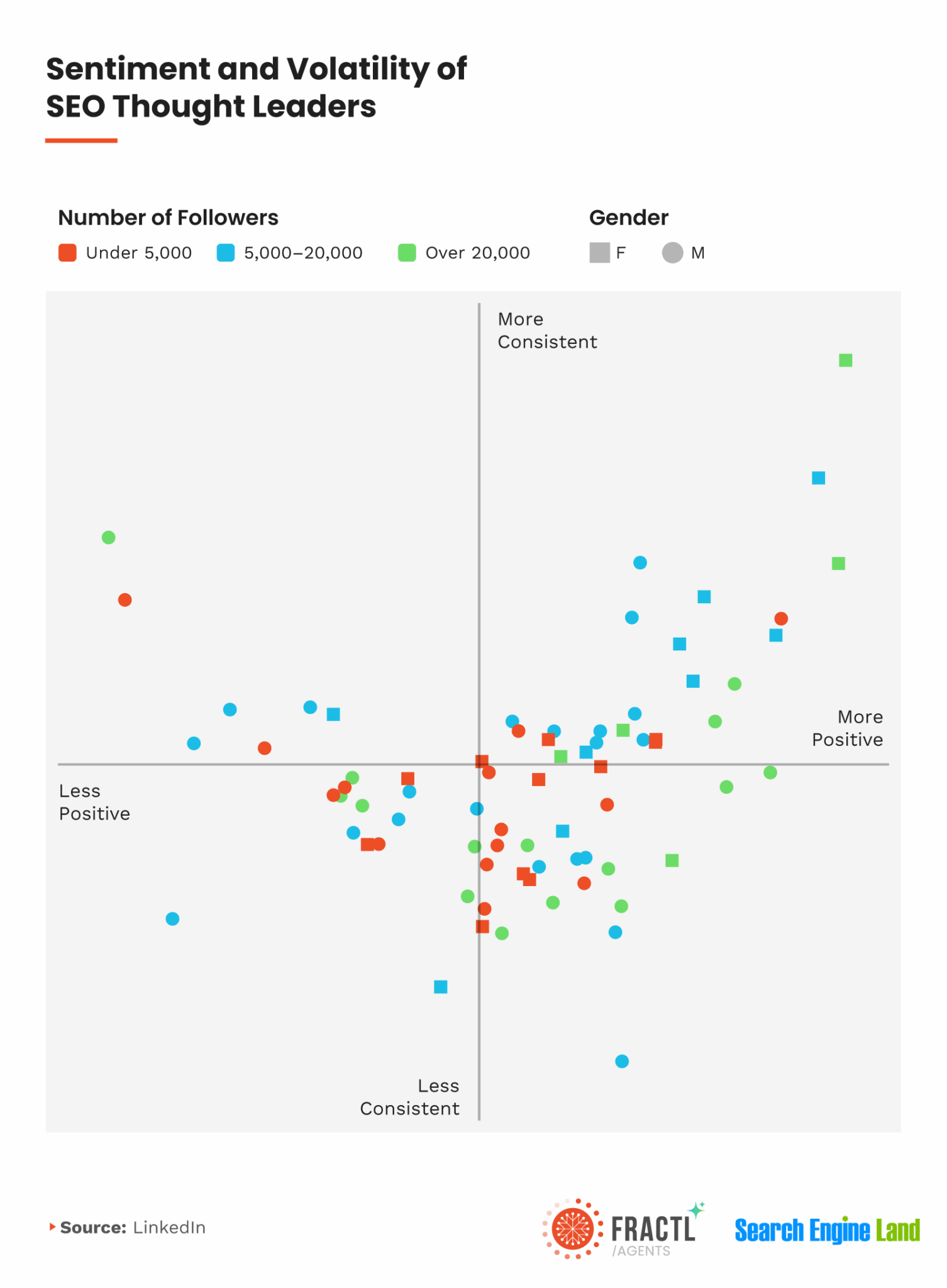
This is the uncomfortable truth: the loudest voices are not always the most reliable ones.
And in an era where guidance shapes budgets, roadmaps, and careers, that distinction matters.
Leaders who maintain measured optimism – grounded in data, tempered by experience – send a different signal than those who swing from hype to skepticism with every update.
Dig deeper: Why every AI search study tells a different story
The key takeaway: This isn’t a strategy reset, it’s an emerging search platform
Effective content marketing, digital PR, and technical SEO establish the foundational strategies for driving cross-channel brand visibility online.
AI is simply a platform modifier, much like social media, not a replacement for the strategies that already work.
Our data shows this isn’t an industry confused about what to do. It’s an industry negotiating how to describe a rapidly evolving discovery system.
That negotiation is normal at this stage. What isn’t – and what erodes trust – is volatility: leaders changing their framing faster than shared understanding can form.
Terms like AEO, LLMO, and AIO may gain traction with general audiences, but they fragment quickly among experienced practitioners.
GEO stands out precisely because it doesn’t.
It maintains consistent sentiment across both practitioners and non-practitioners, acting as a stable explanatory bridge while the execution layer continues to mature.
For marketers, the lesson is straightforward: don’t build a strategy around whatever acronym or platform is trending this quarter.
Build your brand’s digital footprint around timeliness marketing principles:
- Produce content that delivers real value to your target market.
- Repurpose and syndicate that content across the platforms where your audience already engages online.
- Earn citations, engagement, and trust signals that compound across search, social, and AI-driven systems.
In an era where answers are synthesized, not ranked, the most credible voices won’t be the first to coin the next label.
They’ll be the ones who remain coherent long enough for the industry to converge. And that consistency, not speed, is what ultimately compounds into trust, visibility, and results.
The top 75 SEO thought leaders we analyzed focused on tenured agency owners and directors, industry speakers, and consultants, including:
- Aleyda Solis
- Amanda Farley
- Amanda Natividad
- Andrew Holland
- Andrew Prince
- Andy Crestodina
- Areej AbuAli
- Barry Schwartz
- Beth Nunnington
- Brett Tabke
- Brie E. Anderson
- Britney Muller
- Bruce Clay
- Celeste Gonzalez
- Christian Hustle
- Cindy Krum
- Connor Gillivan
- Crystal Carter
- Cyrus Shepard
- Dana DiTomaso
- Danielle Stout Rohe
- Danny Ashton
- Danny Goodwin
- Darren Shaw
- Dave Davies
- Derek Perkins
- Eli Schwartz
- Eric Enge
- Fabrice Canel
- Felipe Bazon
- Garrett French
- Garrett Sussman
- Gisele Navarro
- Greg Gifford
- Ian Lurie
- James Brockbank
- James Wirth
- Jane Hunt
- Jesse McDonald
- Jordan Koene
- Joy Hawkins
- Kathryn Hawkins
- Kelsey Libert
- Kristin Tynski
- Lee Elliott
- Lidia Infante
- Lily Ray
- Loren Baker
- Marc Sirkin
- Mark Rofe
- Mark Traphagen
- Martha van Berkel
- Matt McGee
- Melissa Popp
- Michael Buckbee
- Michael King
- Michelle Robbins
- Mordy Oberstein
- Neil Patel
- Nick Eubanks
- Nick LeRoy
- Noah Learner
- Paddy Moogan
- Patrick Reinhart
- Paul Aaron Norris
- Paxton Gray
- Rand Fishkin
- Ray Grieselhuber
- Ross Hudgens
- Ross Simmonds
- Samantha Torres
- Steven J. Wilson
- Tony Wright
- Vanessa Raath
- Wil Reynolds







Recent Comments