


The future of search visibility: What 6 SEO leaders predict for 2026

The search landscape, today’s buyer journey, and the roadmap to digital success aren’t just shifting. They’re being structurally reimagined.
To make sense of this shift, I spoke with six of the SEO industry’s most forward-thinking voices and distilled their perspectives into seven core predictions for 2026.
What follows is a series of insights into how search is being structurally reimagined.
1. The rise of agentic commerce
We are moving past the era of AI as an answer engine and into the era of AI as an executive assistant.
“Agentic web” means AI won’t just tell you which running shoes are best. It will actually find your size, apply a coupon, and execute the checkout.
For SEOs, this means optimizing for clicks is no longer the ceiling. We must optimize for machine readability and API compatibility.
If an agent can’t parse your inventory or price in real-time, you won’t exist in this new transaction layer.
Jim Yu, CEO of BrightEdge, stressed the importance of agentic preparation:
- “We’re already seeing a massive rise in agentic crawlers – AI that searches and acts on behalf of users. Brands need to prepare now with structured data, clear content hierarchy, and machine-readable information. The winners will be the ones who can measure AI agent behavior and understand how they’re being discovered and recommended.”
Yu elaborated, noting that we’re entering a new market maturity phase.
- “AI search will take the next steps to becoming a real marketplace. The LLMs will expand paid advertising and other paid partnership opportunities. With that will come increased transparency and insights into how people are using LLMs within customer journeys. AI search will move from something that is coming to something that is here and having a major impact. 2026 will be the year that brands solidify the measurement frameworks to understand and respond to that impact.”
Samanyou Garg, founder and CEO at Writesonic, predicted that the agentic web will move users from the discovery phase directly to the transaction phase within a single AI conversation:
- “810 million people use ChatGPT daily. Google AI Overviews hit 1.5 billion monthly users. The debate about whether AI search matters is over. What’s changing in 2026: AI stops recommending and starts buying. The user never leaves the conversation. OpenAI open-sourced their Agentic Commerce Protocol. Shopify merchants enable checkout with one line of code. Amazon saw this coming.”
Crystal Carter, head of AI search and SEO communications at Wix, warned that focusing solely on being found is no longer enough:
- “The future of AI search is optimizing for the AI agents. In the last six months, we’ve seen new protocols for agentic payments, agentic shopping, and agent-to-agent frameworks. These each change the paradigm of the marketing funnel significantly by adding an AI decision gatekeeper into the mix.”
- “I think many search professionals are focusing wholly on being found in classic search or AI surfaces, but ignoring the agentic opportunity is a mistake. SEO and GEO are, of course, valuable, but the agentic layer removes the user from much of the funnel. The so-called messy middle is now managed by AI. If you don’t build for compliance, then you’re not even in the game.”
Key takeaway: If your product, pricing, and availability data is not machine-readable in real time, AI agents will skip you and favor competitors.
2. AI ads will expand with deeper integration
As AI platforms mature, monetization through ads is following suit.
Today, monetization has moved upstream into the generative process itself.
Whether it’s a sponsored product recommendation within a ChatGPT shopping thread or a paid citation in a Google AI Overview, the ad unit has become conversational.
Yu’s prediction:
- “AI responses are now behind every door in the Google SERP – People Also Ask, Maps, Shopping, and more. YouTube is a prime example: one of the most cited sources in AI search and already a monetization powerhouse. Expect more intuitive ad integration within these AI experiences in 2026, which reinforces why brands need to optimize once and win everywhere.”
Garg noted that while AI ad targeting is limited, establishing organic dominance now matters before auctions open:
- “Ads are coming, but the window is now. Google runs ads in AI Overviews across 12 countries, and they’re testing in AI Mode. But brands can’t target these placements yet. Google picks who shows up. Perplexity launched sponsored questions, then paused… ChatGPT shopping is ‘organic and unsponsored’ today. Their CFO says ads are coming. Same pattern as early Google. Organic visibility now means dominant position when the auction opens.”
Key takeaway: Paid visibility will shift from “buying clicks” to “buying inclusion,” and brands that are not already eligible and trusted will pay more and win less.
3. The best SEOs ship tools, not tasks
The barrier between having a marketing idea and building a marketing tool has evaporated.
In 2026, the most successful SEO teams will look less like writers and more like product engineers, with efficiency becoming a competitive advantage.
Garg argued that this year marks the end of the visual workflow era, replaced by natural language tools that let non-technical marketers ship production-level code:
- “The old way: visual workflow builders. Drag nodes, connect arrows, take a three-week course to learn the platform. The new way: Claude Code and tools like it. Describe what you want in plain English. It writes the script, runs it, iterates.”
- “Anthropic’s own growth team uses this daily. Process a CSV with hundreds of ads, identify underperformers, generate new variations. Minutes, not hours. They cut content audit time 75% and reduced costs 70% through intelligent model routing.”
- “The gap between ‘I have an idea’ and ‘it’s running in production’ collapsed. 2026 is the year non-technical marketers start shipping like engineers.”
Key takeaway: Teams that automate repeatable digital marketing tasks will compound output and speed, while manual teams fall behind on both cost and time to impact.
Get the newsletter search marketers rely on.
See terms.
4. Personalization and specialization will keep changing the optimization game

In 2026, the concept of a traditional ranking may finally become obsolete.
If every search result is personalized in real time based on a user’s entire digital history, there is no “Position 1” anymore – there is only intent and relevance.
While Google and OpenAI dominate the headlines, the next frontier also includes specialization.
As users grow weary of hallucinations in general models, they will increasingly turn to AI platforms built for specific, high-stakes niches.
As a result, AI strategy can’t be mono-platform. Brands will need to optimize for a fragmented ecosystem of AI models that prioritize different data sources.
Mike King, CEO of iPullRank, predicts the death of the generic SERP:
- “In 2026, personalization stops being a feature and becomes the operating system. Google’s Nested Learning work makes the direction obvious. Search systems are no longer learning just from queries. They are learning from you across multiple time horizons. Fast signals like session behavior and immediate intent sit on top of slower, more stable models of how you think, decide, trust, and revisit information over time.”
- “The system is not adapting results. It is adapting itself to the user. The practical outcome is that two people asking the same question are no longer in the same information universe. They are getting different answers, different sources, and different levels of explanation based on how the system has learned to serve them without friction or failure. This quietly kills the idea of a single ranking, a single SERP, or a single ‘best page.’ If your content only works for a generic user, it works for no one.”
But this shift is not limited to Google. As users seek more reliable, specialized answers, the search ecosystem continues to splinter across platforms and vertical-specific models.
Key takeaway: Performance will vary by audience segment rather than a single SERP position, meaning brands can be invisible to high-value buyers even while overall rankings appear stable, creating hidden pipeline risk.
5. SEO splits: Humans vs. agents
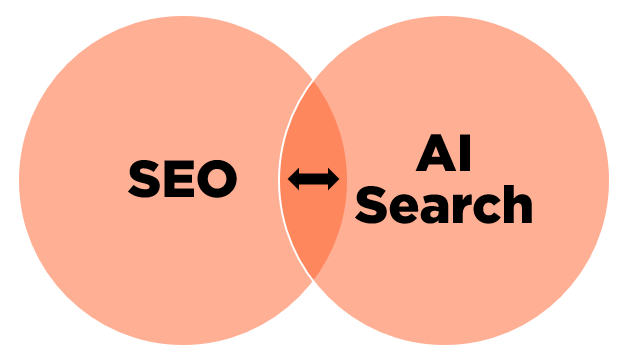
SEO and AI search will continue to fragment.
Historically, SEO had one goal: get the click. Sites were optimized so a human would discover a brand and land on a page.
In 2026, the industry is splitting into two distinct strategic problems.
- Traditional SEO, focused on humans who want to browse, compare, and buy.
- AI search optimization, focused on supplying information so AI agents can find, trust, and use it without a user ever visiting the site.
This is not just a technical update. It represents a fundamental shift in how success is measured.
King explained why treating these as the same strategic problem is a mistake:
- “Most people think AI search is just SEO evolving. There will be real tactical overlap for a while, and that is not the issue. The mistake is treating it as the same strategic problem. SEO is built around earning visibility that converts into clicks. AI search is built around supplying information that can be extracted, trusted, and reused without a click ever happening. They keep optimizing for rankings and traffic while the system is optimizing for reliability, composability, and downstream usefulness.”
- “The work still matters. But the reason it matters has fundamentally changed, and most people have not caught up to that shift yet. We now live in a world where people form relationships with systems that listen, remember, adapt, and respond with context and continuity. That is not a search problem. That is a worldview shift.”
- “In 2026, the biggest risk is not that SEO dies. It is that the people who should lead this moment choose to stay small, and the relevance engineers build the future without them.”
Britney Muller, AI educator and consultant, cautioned that applying traditional SEO logic to AI citations is a strategic failure:
- “The biggest risk to our industry in 2026 isn’t AI; it’s that we’re trying to fit a baseball bat through a keyhole by applying SEO ranking logic to probabilistic systems.”
- “You can’t ‘optimize’ an AI citation like a 2010 keyword. We have to pivot the conversation to what we can actually influence: showing up in the historical training data and winning the real-time RAG layer through fundamental SEO and brand mentions at scale.”
Key takeaway: In 2026, SEO becomes two jobs: driving clicks from humans and supplying clean, trusted inputs for AI agents that may never visit your site.
Measuring success only by rankings and sessions risks missing where revenue is actually influenced.
6. Proprietary data becomes your moat
Unique, proprietary, and human-driven content wins.
As the web becomes flooded with AI-generated material, the value of human experience and owned data continues to rise.
If an AI can easily synthesize your content without needing to cite you, the underlying value is likely interchangeable.
When brands own the data itself, however, attribution becomes unavoidable.
Muller highlighted that building unique, branded datasets is one of the strongest ways to secure AI attribution:
- “My big bet is on brands that start building entity moats … more strategically naming their data. When you own a unique metric, like the ‘[Brand] Index’ or the ‘[Brand] Score,’ you create a source of truth that AI models can’t just synthesize or ignore.”
- “If they can’t replicate your data, they are forced to cite your name. Brands are also getting ahead by harvesting real-world stories and conversations highlighting things that AI cannot do.”
Muller further shares:
- “Content marketers that will find an edge in 2026 will discover savvy ways of leveraging AI to analyze public datasets and then do something really cool and story-worthy with them.”
- “Think about the one million hotel reviews that MonkeyLearn did … which used sentiment analysis to discover nuanced insights.”
Key takeaway: Commodity content becomes a cost center, while proprietary data and real experience become defensible assets that earn citations, trust, and inbound demand.
7. AI literacy becomes a hiring filter
AI adoption and training are critical.
The shift in 2026 is as much about people as it is about technology.
The era of AI novelty is over. Simply using ChatGPT is no longer a differentiator.
The competitive divide now depends on whether teams can move beyond basic content drafting and use AI as a strategic partner tied to real outcomes.
The leaders of 2026 will be those who successfully connect AI usage to key performance indicators.
Neil Patel, CEO and co-founder of NP Digital (Disclosure: I am the vice president of SEO at NP Digital), pointed to a broader hiring shift, citing comments from AMD CEO Lisa Su, and elaborates:
- “Companies are racing to get mentioned on AI platforms in 2026, but much of that carries over from traditional SEO. Where marketers and marketing departments are going to see the big lift from 2026 is getting their team to use the right tools and focus on the right tasks when it comes to AI.”
- “We are seeing adoption rates skyrocket in organizations, but when you look at increased ROI from these AI efforts in marketing, it doesn’t look that great. So in 2026, we will focus more on training and helping teams understand and use AI to improve their KPIs. This way, usage and costs are more closely tied to growth.”
Key takeaway: Companies that operationalize AI into repeatable processes tied to KPIs will gain margin and velocity, while everyone else pays for tools without measurable lift.
What winning visibility looks like in 2026
In 2026, winning visibility will be less about chasing rankings and more about becoming the most usable and trustworthy input for humans, AI answers, and autonomous agents alike.
Brands that invest now in machine-readable data, proprietary moats, and AI-literate teams will be the ones thriving in 2027.







Recent Comments