

Inside Meta’s AI-driven advertising system: How Andromeda and GEM work together
When Meta launched advertising nearly two decades ago, performance was driven by manual inputs – targeting rules, account structure, and incremental optimization.
Success depended on carefully defined audiences, granular budget control, and frequent testing.
That operating model eroded over time as privacy changes and signal loss made deterministic targeting less reliable.
Over the last two years, Meta responded by fundamentally rebuilding its advertising platform around AI.
That rebuild began with Andromeda, a personalized ads retrieval engine, and expanded into Meta’s Generative Ads Recommendation Model (GEM).
Together, these systems now determine how ads are selected, ranked, and delivered across Meta’s ecosystem.
Meta Ads is no longer an open, manual optimization environment. Performance now depends on understanding how the system evaluates inputs and learns over time.
This article breaks down how Andromeda and GEM work, how they changed ad delivery, and what it takes to align strategy with Meta’s AI-first advertising system in 2026.
Andromeda: Meta’s first major AI overhaul
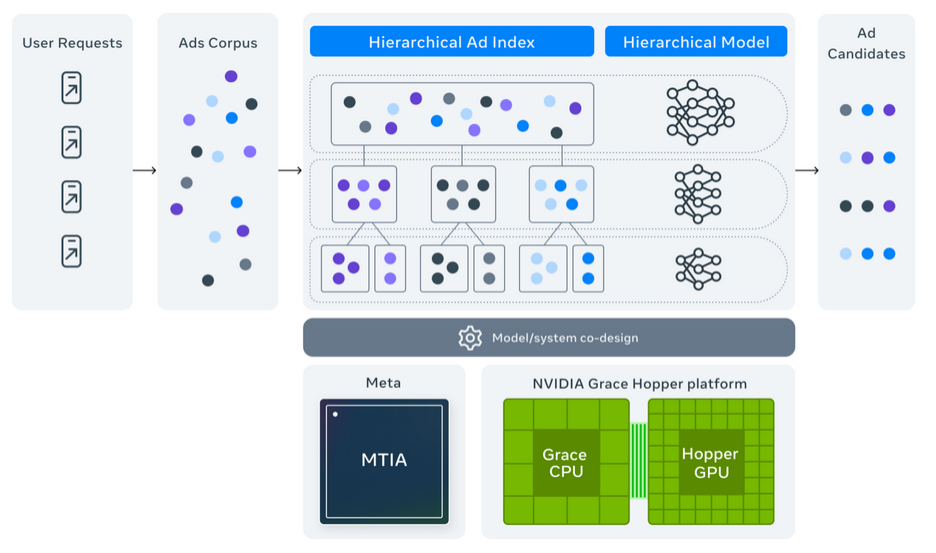
Andromeda is Meta’s AI-driven ads retrieval system that decides which ads are eligible to be shown to a user.
Instead of starting with advertiser-defined audiences, it works in reverse, by first evaluating historical engagement, ad copy, creative, and format.
This helps Andromeda predict which users are most likely to engage with the ad and contribute to your campaign optimization goals.
This AI system began rolling out in late 2024. In 2025, Andromeda became a core component of Meta’s updated infrastructure.
Advertisers saw changes firsthand as:
- Broad targeting began to outperform previous top-performing interest stacks.
- Simplified account structures started to win.
- Creative fatigue accelerated.
These were blatant signals that ad retrieval had changed.
What Andromeda changed
With the rollout of Andromeda, Meta shifted away from audience-first advertising to creative-first matching.
Targeting became less deterministic as interests and lookalikes no longer performed as strongly as they once did.
Instead, creatives became the primary signal as the system evaluated creative elements like visuals, themes, hooks, and language to determine relevance.
AI drives better performance when it has a larger opportunity pool to draw from.
Broader campaigns with more creative inputs give the system more options to match ads to users to achieve campaign goals.
Enter GEM: Meta’s central AI brain
GEM is Meta’s large-scale generative AI system that acts as the ad platform’s central intelligence.
It identifies patterns across organic interactions and ad sequences, formats, and messaging, synthesizing engagement, behavioral, and conversion data.
Most importantly, GEM feeds predictions into Andromeda. These insights help predict what works best, for whom, and when, at scale, while continuously learning.
GEM began rolling out in mid-2025, with broad impact by Q4 2025.
It’s now “4x more efficient at driving ad performance gains” compared to original ads recommendation ranking models, according to Meta.
Why GEM is a bigger shift than Andromeda
Andromeda decides what can be shown, while GEM determines what should be shown next.
Think about it like this: Andromeda decides which ads make it onto the shelf, while GEM learns what shoppers buy and shapes what gets featured next.
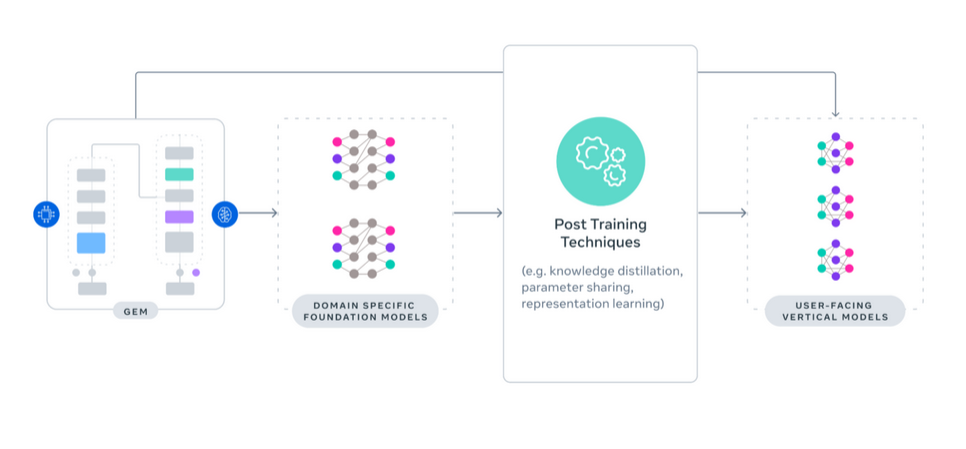
Source: Engineering at Meta
Advertisers who have become accustomed to fast testing cycles and frequent edits will require a bit of a mindset shift in 2026 as long-term patterns matter more than short-term performance fluctuations.
Ads are increasingly evaluated within broader contextual journeys.
Dig deeper: Rethinking Meta Ads AI: Best practices for better results
Get the newsletter search marketers rely on.
See terms.
What Meta’s AI stack means for advertisers in 2026
Advertisers can position themselves for stronger performance this year by shifting efforts toward creative strategy and diversity, simplifying account structure, and embracing patience and stability.
Consider creative strategy the core lever
This year, lean into signaling by serving Meta a buffet of variables.
- Test creative angles tailored to various personas – not just micro-variations.
- Create clear video hooks with strong statements and questions that communicate value quickly.
- Implement a diverse selection of formats that include images, videos, carousels, user-generated content (UGC), and testimonials.
Focus on creating more creative variations and setting up a scalable system.
These tactics will give Meta’s AI more to work with and thus deliver more results.
Dig deeper: How to test UGC and EGC ads in Meta campaigns
Simplify structure for better performance
The days of hyper-segmentation are gone. Instead, consolidate campaigns and ad sets.
With this tactic, we’ve already seen tremendous improvement in client accounts.
In some accounts, it’s now become typical to see only one or two campaigns.
Having fewer campaigns, broader targeting, and consolidated budgets allows Andromeda and GEM to learn faster and identify winning patterns.
It may be challenging to relinquish that control, especially if you’ve been working on the platform for years.
But you’ll slow down learning if you avoid applying these best practices or if you prioritize the manual boundaries that are still available (for now).
Embrace learning stability
Refrain from adjusting ad elements too often, as frequent edits reset the learning phase and can interrupt pattern recognition.
Patience is a competitive advantage given the current state of the system.
Early volatility is common and doesn’t necessarily signal failure. Before launching new campaigns or assets, decide on a minimum no-touch window.
This may be a week or 50-75 conversions (whichever comes first), where you commit to not making any changes unless something is truly broken.
Looking at rolling performance windows, such as three- to seven-day trends, instead of daily spikes. This can help you understand how the system spends, performance, and evaluates success.
Treat your budget as a signal
As with most advertising platforms, more budget helps you learn faster, get more results, and optimize more quickly.
You could get by with a lower budget in Meta Ads. But it may be more challenging, as low spend limits learning ability.
Meta performs best when budgets allow campaigns to generate consistent conversion data, creating enough volume for the system to detect trends.
Ensure that your daily budget is realistic and aligned with the ad set’s conversion event.
High-intent events, such as purchases or qualified leads, require more ad spend per learning cycle than upper-funnel actions, such as engagements or clicks.
Rethink your role as an advertiser
With hand-picked targeting strategies now a thing of the past, we’re no longer manual optimizers.
Instead, we should level up as strategists and creative architects. This way, we can help our brands and clients:
- Define clear brand positioning.
- Create strong creative inputs.
- Collaborate with design teams to build scalable creative development processes.
- Set guardrails for brand integrity.
As humans, it’s our responsibility to provide judgment and develop novel ideas while Meta’s AI handles better targeting and optimization with the data it has.
Dig deeper: 3 PPC myths you can’t afford to carry into 2026
How to win in Meta’s AI-first ecosystem
From what we’ve seen transpire on the platform in the last few years, Meta has made its direction unmistakably clear: AI is now the foundation of Meta Ads.
If you embrace it and complement it with human guidance, you can succeed and scale.
Trusting the system now is more important than ever because Meta’s AI is a determining factor of success.
Succeeding with Meta Ads in 2026 comes down to feeding the platform diverse, high-quality inputs and creating strategies and content that align with how Meta’s AI learns and optimizes.
The tools have changed, but the opportunity to get creative and find success hasn’t.








Recent Comments