

The local SEO gatekeeper: How Google defines your entity
Most businesses don’t fail to rank in the local pack because they lack reviews, links, or proximity.
They fail long before that because Google never considers them eligible in the first place.
This is a recurring pattern in local search that almost everyone overlooks.
Google decides what you are before it decides how relevant you are.
From exact matches to broad intent: How eligibility shifts
In a niche query, Google is looking for a 1:1 match. They want high-confidence entities that leave zero room for interpretation.
However, once you zoom out to a broader search like “restaurants,” that lockdown disappears.
Suddenly, the Map Pack opens up to a variety of related categories.
This is where hidden ranking factors like clicks, NavBoost, reviews, and even real-time signals like openness are prioritized.
Your business name and category create a unified signal that defines your “entity boundary.”
For thousands of businesses, a name that is too specific acts as a technical anchor, preventing them from appearing in those high-value, broad-intent Map Packs.
Conversely, for those trying to dominate a niche, aligning your name and category perfectly is the ultimate “cheat code” for eligibility.
Dig deeper: How to pick the right Google Business Profile categories
The eligibility gatekeeper: Interpretation first, rankings second
The reality is that you aren’t just competing against other businesses; you are competing against Google’s own need for certainty.
Thanks to the Google Content Warehouse API Leak, we now have visibility into the engine driving this NlpSemanticParsingLocalBusinessType.
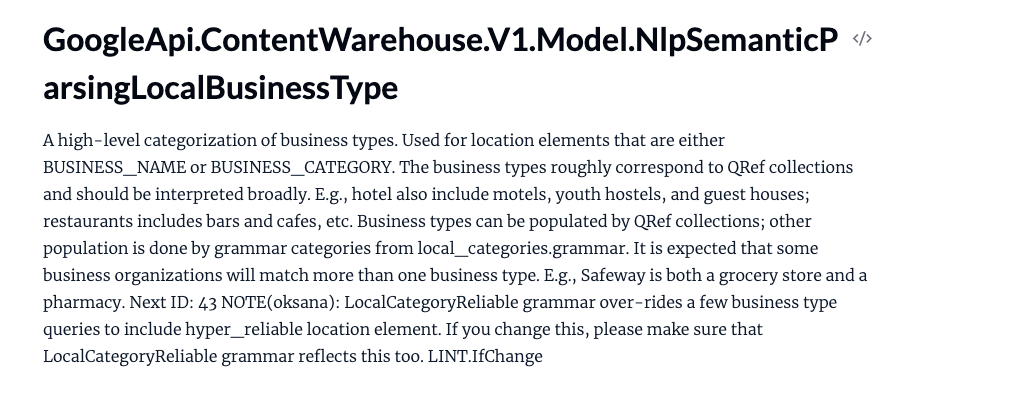
This is the upstream “brain” that decides whether your business is even eligible to show up for a query before traditional ranking factors like reviews, links, or proximity are ever considered.
Think of it as a machine learning classifier designed to minimize noise.
By filtering out businesses that are semantically unlikely to be a match for a query, Google ensures its Map Pack results are highly confident.
If you don’t pass this semantic filter, your 500 five-star reviews don’t even get looked at.
This is why, if Google’s parser identifies the combination of your business name and primary category as a narrow entity boundary, you are immediately limited in the queries you can compete for.
Your business name and primary category do more than describe you.
They dictate your eligibility for specific queries.
They are the fundamental building blocks of your digital territory, setting the invisible walls of where you are and aren’t allowed to rank.
Business name + category: A unified signal
The leaked documentation reveals that Google evaluates your business name and business category as part of a single locationElement.
These aren’t just two fields in a database. They are parsed through the same semantic model in parallel.
But they serve very different roles in the parsing process:
- Business name = semantic tokens: This is your self-identification signal. Google extracts raw language tokens from your name to infer niche, scope, and intent. Every word in your name is a signal of “what you are.”
- Business category = structured authority: Backed by the
LocalCategoryReliablegrammar referenced in the leak, this is the tie-breaker. Categories are structured, curated Google category IDs (GCIDs), not free-text inputs.
The category provides a taxonomy-based definition that usually overrides minor naming ambiguities.
However, when your name contains a highly specific token like “pizza” or “grout,” it creates a narrow “entity boundary.”
This forces the algorithm to interpret your business with a limited scope, making it very difficult to rank up into broader categories unless you have behavioral signals to back it up.
Dig deeper: Google’s Local Pack isn’t random – it’s rewarding ‘signal-fit’ brands
Tokens, categories, and SAB eligibility
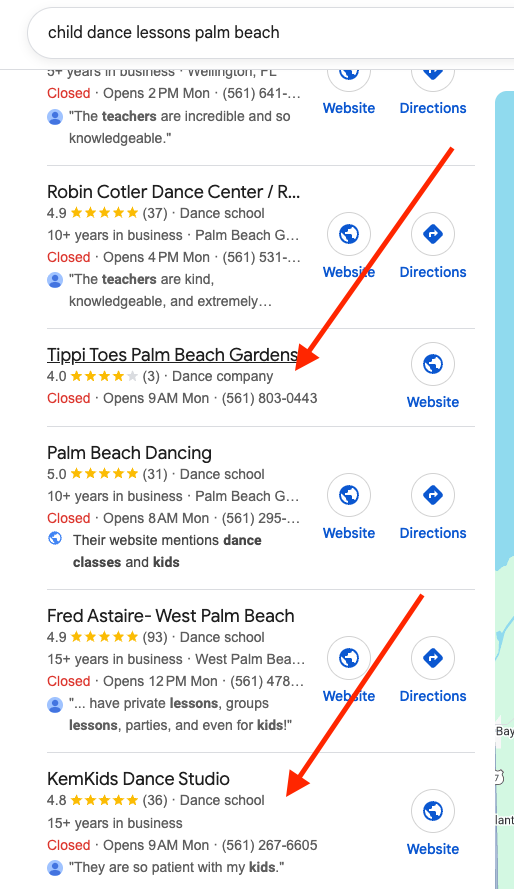
When searching “kids dance lessons Palm Beach” and “child dance lessons Palm Beach,” a clear pattern emerged in the Map Pack. Two service area businesses (SABs) appear:
- Tippi Toes Palm Beach Gardens (Position 4).
- KemKids Dance Studio (Position 7).
Both listings use hidden addresses. Neither appears for the broader query “dance lessons Palm Beach.”
A closer look shows their primary categories differ:
- KemKids is categorized as a Dance School.
- Tippi Toes is categorized as a Dance Company.
Despite the category difference, both listings surface for child-specific searches and fail to appear for the broader dance lesson query.
Based on what we know from the Google API leak, Google evaluates entity relevance before ranking.
For SABs, relevance signals in the name can help shape entity interpretation, allowing them to surface for specific queries.
In these examples, the business name provides an explicit age qualifier that closely aligns with the search intent.
Dig deeper: GEO x local SEO: What it means for the future of discovery
The ‘smoothie’ anchor
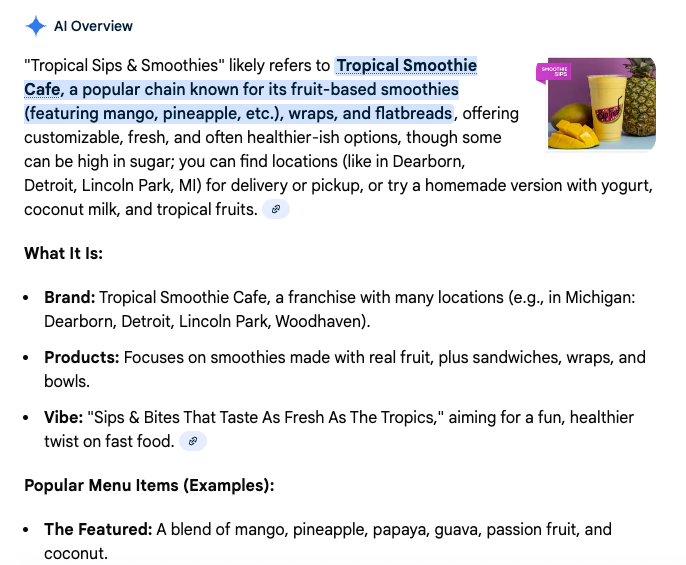
Picture a cafe called “Tropical Sips & Smoothies.”
They’ve got a smoothie lineup, daily specials, hot sandwiches, and salads.
But their brand name tells Google one thing loud and clear: This is a smoothie shop.
The conflict?
In Google’s semantic parsing, business names aren’t just labels. They’re tokenized identity signals.
Words like “smoothies” and “sips” create a strong beverage-first classification that can overpower weaker “secondary signals” (a few lunch mentions in reviews, a couple photos of sandwiches, etc.).
As a result, when someone searches “smoothie near me,” Google has high confidence in eligibility.
But when the query shifts to “lunch near me,” the system tends to prioritize broader meal categories.
Tropical Sips & Smoothies can still rank, but it often needs unusually strong validation (behavioral signals, prominence, repeated lunch language in reviews) to break out of the beverage boundary.
If you want to win broad-intent queries, don’t brand yourself as a niche specialist unless you are willing to fight against the constraints of your own entity boundary.
Get the newsletter search marketers rely on.
See terms.
Category doesn’t always decide – sometimes Google just reads the sign
In a world where SEOs spend thousands on schema markup and website content, Google’s parser can still take shortcuts.
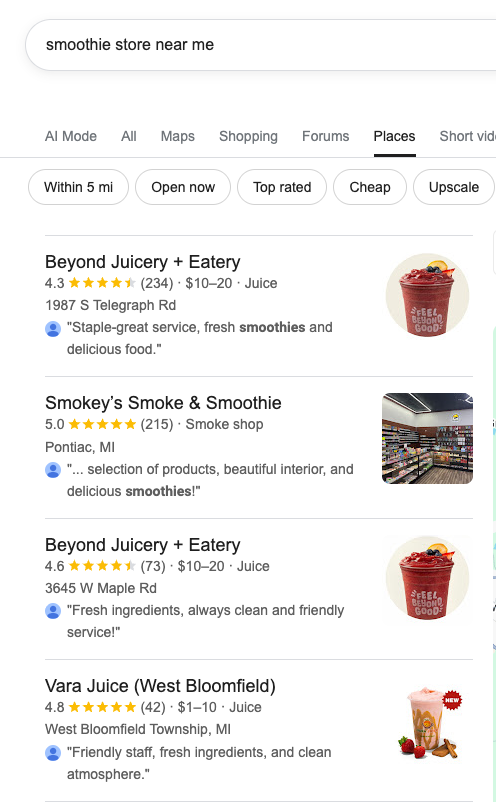
Faced with a business called Smokey’s Smoke & Smoothie – categorized as a smoke shop with no website, no menu, and zero secondary categories – the system concludes, “Yes, this is where I should send someone for a smoothie fruit beverage.”
Put “smoothie” in the name, and Google will often ignore the fact that the business also sells glass pipes and rolling papers.
The algorithm isn’t just reading the sign. It’s effectively ignoring the entire store behind it.
Case study: Why secondary signals fail (halal vs. steakhouse)
I recently ran a test that showed how literal this “gatekeeper” function really is.
The analysis focused on a high-traffic restaurant with strong halal signals across nearly every surface.
- The website referenced halal.
- GBP attributes were set to halal.
- “Halal restaurant” was added as a secondary category.
- Yelp was optimized for halal.
The business had PR coverage and influencer mentions tied to halal dining, and reviews repeatedly praised the halal menu.
Despite all of this, the business was invisible for “halal restaurant” searches.
The reason was simple. The primary category was set to “steakhouse.”
To test the impact, I changed the primary category to “halal restaurant” and updated the website’s meta title to match.
The result was immediate.
Ranking grids flipped from deep red to solid No. 1s across the city.
All of those secondary signals – reviews, attributes, content, and mentions – didn’t matter until the primary category gave Google the semantic permission to show the business for that query.
This illustrates a critical point. Google needs clear, top-level cues to understand what your business is before it considers how good you are.
Interestingly, this limitation exists deep in the code.
The category steak_house is treated as a specialty dining classification.
Unlike categories that end in _restaurant, it lacks a broader “restaurant” entity scope.
As a result, businesses using it as a primary category often dominate steak-specific searches but struggle to compete for broader queries like “restaurant” unless they accumulate unusually strong validation signals.
The validation layer: Clicks and visits
If your name or category is anchoring you too deeply in a niche, you need to provide ground truth to Google to expand that boundary.
The leak confirms that once the parser interprets your entity, Google validates that interpretation through real-world behavior:
visitHistory: This confirmed ranking factor uses foot traffic patterns to validate a business’s prominence. If people frequently visit your “steakhouse” for dinner, it reinforces your authority in that category.clickRadius50Percent: Google calculates the geographic radius where your business receives 50% of its clicks. A wider “click radius” signals that you are a “destination” entity with a broader reach, which can help stretch your entity boundary further than a purely local name would suggest.- NavBoost: This system tracks “good clicks” and “longest last clicks.” If users search for “lunch” and consistently click your listing and stay there, Google’s NavBoost system can eventually override a narrow name interpretation by observing that you satisfy the user’s intent.
The 2026 strategy: How to re-anchor your entity for local search
Expanding your entity boundary requires consistent proof that your business operates at a broader scope.
If you are stuck in a niche lockdown, you need to counterbalance your name with evidence.
- Website authority (service pages): Your website must provide the primary proof. Creating authoritative service pages, localized for broader services, helps shift your site’s identity from a narrow focus to a broader entity.
- GBP category alignment: While your business name provides the semantic tokens, the primary category provides the structural permission for Google to consider you a candidate for the larger query. Secondary categories should then be used to reinforce specific niches.
- Behavioral reinforcement: Focus on driving “branded” clicks and real-world visits.
Dig deeper: Want to win at local SEO? Focus on reviews and customer sentiment
Eligibility comes before ranking
Local rankings aren’t just about optimization. They’re about confidence.
Google ranks what it understands and suppresses what it doesn’t.
Here’s the part most businesses don’t understand.
You have to evaluate your business name and primary category against the specific queries you’re trying to win.
Eligibility isn’t universal. It’s query by query.
If your primary category is limiting your ability to rank for the terms that matter most, reexamine the strategy.
You can keep stacking secondary signals, but if the top-level classification is telling Google you’re not that, you may be wasting effort because Google has already made its decision.
Not every keyword is worth chasing on Google.
If the query you want requires an identity shift you’re not willing to make, it may be smarter to push those “secondary signals” through other channels – ads, social platforms, creator partnerships, PR, and other third-party directories.
Then let Google catch up later through branded demand and real-world behavior.
Stop thinking about rankings.
Start thinking about how Google interprets the very soul of your business and whether the queries you’re chasing are worth the price of admission.







Recent Comments