

How digital marketing agencies are adapting to AI search by Editorial Link
AI search platforms like ChatGPT, Perplexity, Gemini, and Google’s AI Overviews are reshaping how people discover information.
Digital marketing agencies feel the impact firsthand and must adapt quickly. They need to keep their services relevant, their processes outcome-driven, and their results easy to prove.
This article explores how 10 agencies have updated their strategies, services, and client relationships to win in the AI search era.
What AI search changes for digital marketing agencies
Semrush predicted that AI search will surpass organic traffic in 2028.
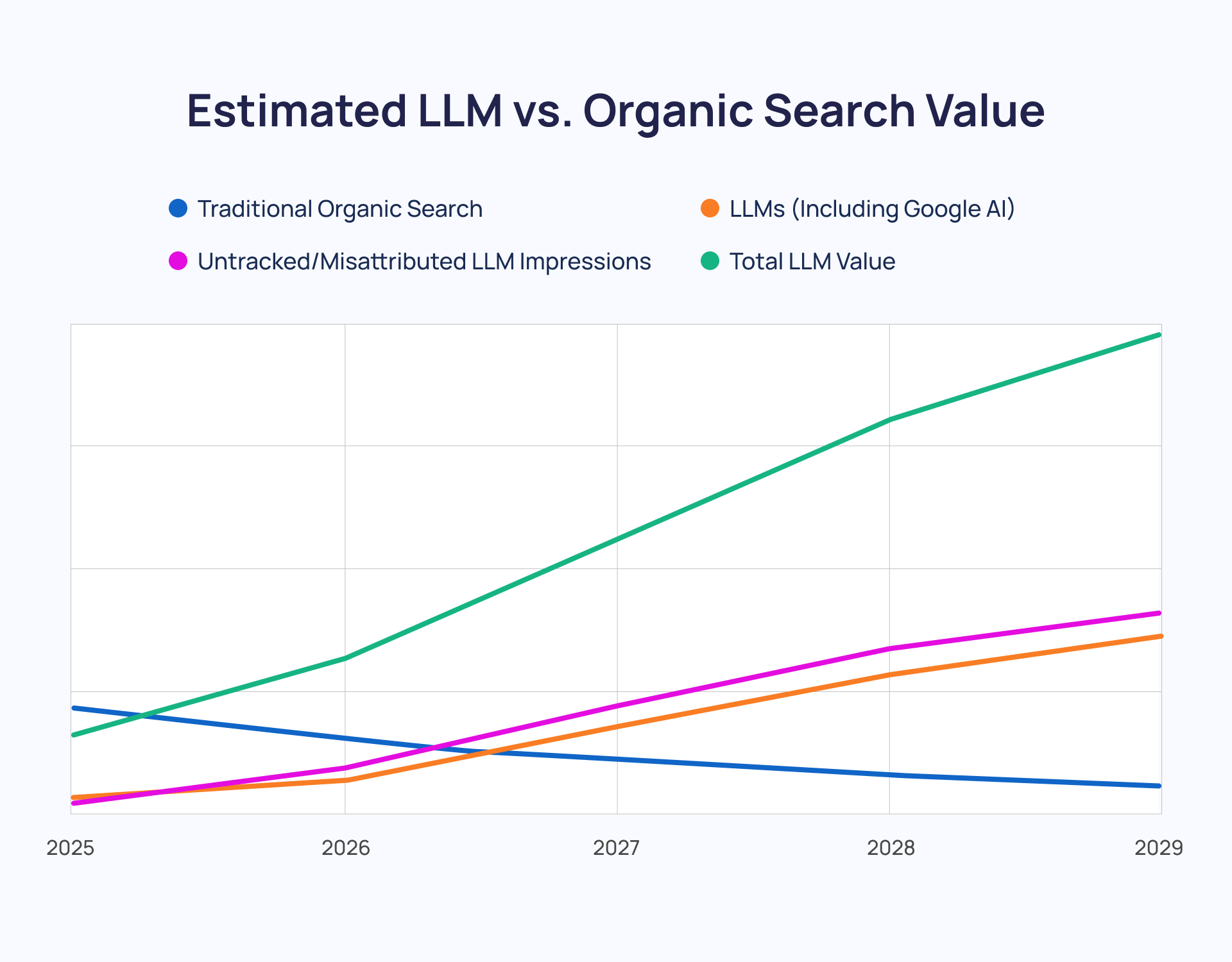
It’s easy to see why. A growing number of people now start their searches with AI instead of Google or Bing.
For informational queries, the journey often ends there. The AI assistant — ChatGPT, Perplexity, or Claude — delivers a complete answer inside the interface, not a blue link to click. AI Overviews do the same, which explains the sharp drop in click-through rates.
AI also compresses the customer journey. Instead of moving through multiple touchpoints, customers research products directly with AI. That’s why AI traffic converts 440% better than organic visits.
Surpass doesn’t mean replace. Even as AI grows, people still use Googe — more than ever. For example, to verify the AI recommendations.
What does this shift mean for agencies?
A few priorities stand out right away:
- Expand offerings to meet demand for AI search optimization while keeping organic search strong.
- Educate clients on how search is changing and why AI search matters.
- Introduce new metrics that reflect performance in an AI-driven landscape.
- Shift toward value-based selling and prove ROI as attribution gets harder.
How agencies adapt to the new reality
We spoke with 10 industry leaders to learn how they’ve updated their processes and strategies to meet these new challenges.
Listicle placements replacing traditional link building
Editorial.Link, a digital PR and link building agency, shifted its focus to listicle placements.
Why?
“Recent studies show that listicles are among the most frequently cited sources in AI search results,” said Dmytro Sokhach, founder of Editorial.Link. As a result, clients increasingly want listicle placements to boost the chances of their brands being mentioned.
To support this shift, Editorial.Link built Listicle.com, an AI-powered tool that helps companies find relevant “best of” lists for brand placement.
Shifting from keyword optimization to brand entity building
Ignite SEO, a London-based agency, moved beyond keyword-first optimization to focus on search intent and building recognizable brand entities.
“We’re connecting the dots between content, expertise, and reputation,” said Adam Collins, founder of Ignite SEO. “The goal is to ensure that when AI engines search for trusted voices in a space, they need to know exactly who our clients are and why they matter.”
Behind the scenes, Ignite SEO tightened up its technical SEO processes, putting more emphasis on structured data and clean site architecture.
“It’s less about black hat versus white hat now and more about building trust and clarity, making it easy for both humans and machines to understand us,” Adam added.
Ignite SEO isn’t alone. More agencies now prioritize entity, authority, and intent optimization over keyword-first tactics.
Ben Foster, CEO of SEO works, said that an SEO agency’s job is to make its clients easy for machines and people to understand.
“The fundamentals of SEO (quality content, technical excellence, and citations) are still key, but success now also depends on helping AI systems interpret those signals correctly, “ Foster said.
Rocky Pedden, CEO of RevenueZen, agreed.
“Agencies redesign content for LLM consumption, meaning clearer structure, stronger expert signals, and schema that helps models interpret credibility,” Pedden said.
Testing what content structures LLMs favor
High Voltage SEO experiments with content structures and on-page formats to influence how Google and AI tools extract information.
“Content must do more than rank,” said Julia Munder, general manager and senior SEO strategist at High Voltage. “It must be organized so AI can summarize it accurately and confidently.”
Testing sits at the core of the agency’s approach. The team identifies which formats large language models extract most reliably, then applies those patterns across client sites.
Reverse-engineering AI ranking signals
SEO Inc. has developed proprietary AI prompt frameworks to analyze SERPs, extract ranking signals, and run competitive intelligence at scale.
“We’ve engineered systems that parse search results and reverse-engineer ranking factors with 96% baseline accuracy for paid search,” said Garry Grant, CEO at SEO Inc. “Our organic SEO AI models are more complex due to the multifaceted nature of ranking signals, but the directional insights are transformative.”
Grant believes the real differentiator will be how agencies use AI to decode search algorithms, anticipate SERP volatility, and uncover ranking opportunities — not just to generate content.
Agencies that lack AI infrastructure for competitive analysis risk losing their edge.
“The question isn’t whether to adopt AI — it’s how quickly you can operationalize it before your market position erodes,” Grant added.
Shifting toward search everywhere optimization
SEO Sherpa shifted from pure organic search to search everywhere optimization.
“The role of agencies now is to optimize not just for Google, but for the entire ecosystem of AI-driven discovery,” said Jenny Abouobaia, owned media manager at SEO Sherpa.
In practice, this means making sure their clients are visible, trusted, and recognizable across traditional search, generative engines, and platforms like Pinterest, TikTok, and Instagram — wherever their audience spends time.
Pedden sees the same trend.
“Agencies move beyond ranking pages and focus on becoming the best answer, wherever that answer is generated,” Pedden said.
In his opinion, to stay relevant, one will have to “treat AI search as a distribution channel, not a threat.”
Optimizing reviews for local citations
For local businesses, AI search raises the importance of review platforms, especially Google.
“By reaching top ranks on Google reviews in Google Maps or the local pack, businesses enjoy a high likelihood of being recommended by LLMs,” said Robert Newman, founder and CEO of InboundREM.
SEO agencies can boost client results by running targeted review campaigns. The key is encouraging reviews that mention local place names, such as neighborhoods.
InboundREM data revealed that reviews containing local place names outperform competitors in LLM recommendations.
Adding AI visibility as a core KPI
SeoProfy is one of the agencies that has built AI visibility tracking into its workflow.
Alongside traditional SEO metrics, the team monitors LLM mentions.
“This includes analyzing competitors, identifying which brands are cited by different chatbots, and for which queries,” said Victor Karpenko, CEO of SeoProfy.
SeoProfy uses these insights to shape strategies that increase client visibility across multiple AI platforms.
Blending GEO into existing SEO packages
First Rank initially treated AI search as a separate service. After testing, the team found that clients — especially local businesses — benefit more from integrated offerings.
“We’re sprinkling GEO-related tasks into SEO campaigns,” said Terry Williams, head of SEO at First Rank.
To prove impact, the agency built custom Looker Studio reports that highlight referral traffic from LLMs. They use those insights to demonstrate value and upsell expanded services.
How your agency needs to adapt to AI search
The patterns across these 10 agencies point to clear shifts:
- From rankings to visibility. Success now means showing up in AI-generated answers, not chasing the #1 Google spot.
- From keywords to entities. Optimization centers on building recognizable, trusted brand entities, not individual search terms.
- From traffic to authority. Link building has evolved into brand building, with backlinks serving as authority signals.
- From measurement to influence. Traditional analytics miss AI search impact. Leading agencies track LLM citations, build custom measurement systems, and prove value through multi-touch attribution.
- From SEO to search everywhere optimization. Agencies can’t focus only on Google when discovery happens across ChatGPT, Perplexity, and AI Overviews.
The fastest-moving agencies share one trait: they test aggressively, measure what they can, and educate clients on a shifting landscape — while others still debate whether AI search even matters.






Recent Comments